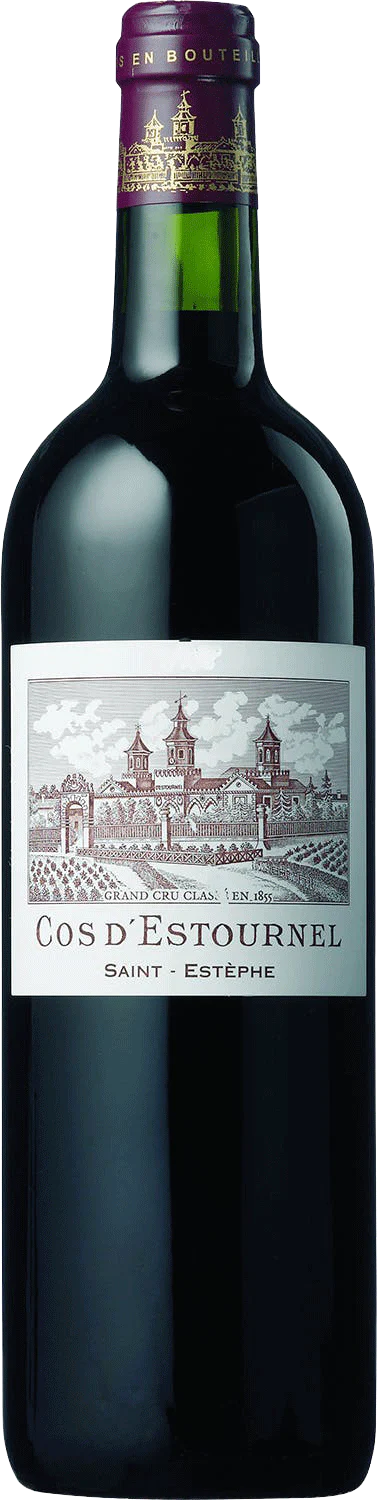
Chateau Cos d'Estournel 2022
Château Cos d'Estournel is indeed named after its 19th-century owner, Louis-Gaspard d'Estournel. He was responsible for constructing the distinctive oriental-style architecture that has become a notable landmark in the Médoc region of Bordeaux, France. Today, Cos d'Estournel is widely recognized as the leading estate in the St-Estéphe appellation.
The estate is situated in the southern part of the St-Estéphe appellation, close to the border with Pauillac. Its vineyards are strategically positioned on a south-facing gravel ridge with a significant clay content. This terroir contributes to the exceptional quality of the wines produced at Cos d'Estournel.
The typical blend of Cos d'Estournel consists of 60% Cabernet Sauvignon, 38% Merlot, and 2% Cabernet Franc. Despite the relatively high proportion of Merlot, the wines are known for being full-bodied, dark, and brooding when young, with pronounced tannins. As they mature, these wines develop complexity and intensity that can rival those of many esteemed Pauillac classified growths.
$123.44
Original: $411.47
-70%Chateau Cos d'Estournel 2022—
$411.47
$123.44Product Information
Product Information
Shipping & Returns
Shipping & Returns
Description
Château Cos d'Estournel is indeed named after its 19th-century owner, Louis-Gaspard d'Estournel. He was responsible for constructing the distinctive oriental-style architecture that has become a notable landmark in the Médoc region of Bordeaux, France. Today, Cos d'Estournel is widely recognized as the leading estate in the St-Estéphe appellation.
The estate is situated in the southern part of the St-Estéphe appellation, close to the border with Pauillac. Its vineyards are strategically positioned on a south-facing gravel ridge with a significant clay content. This terroir contributes to the exceptional quality of the wines produced at Cos d'Estournel.
The typical blend of Cos d'Estournel consists of 60% Cabernet Sauvignon, 38% Merlot, and 2% Cabernet Franc. Despite the relatively high proportion of Merlot, the wines are known for being full-bodied, dark, and brooding when young, with pronounced tannins. As they mature, these wines develop complexity and intensity that can rival those of many esteemed Pauillac classified growths.